Everything Has a Price
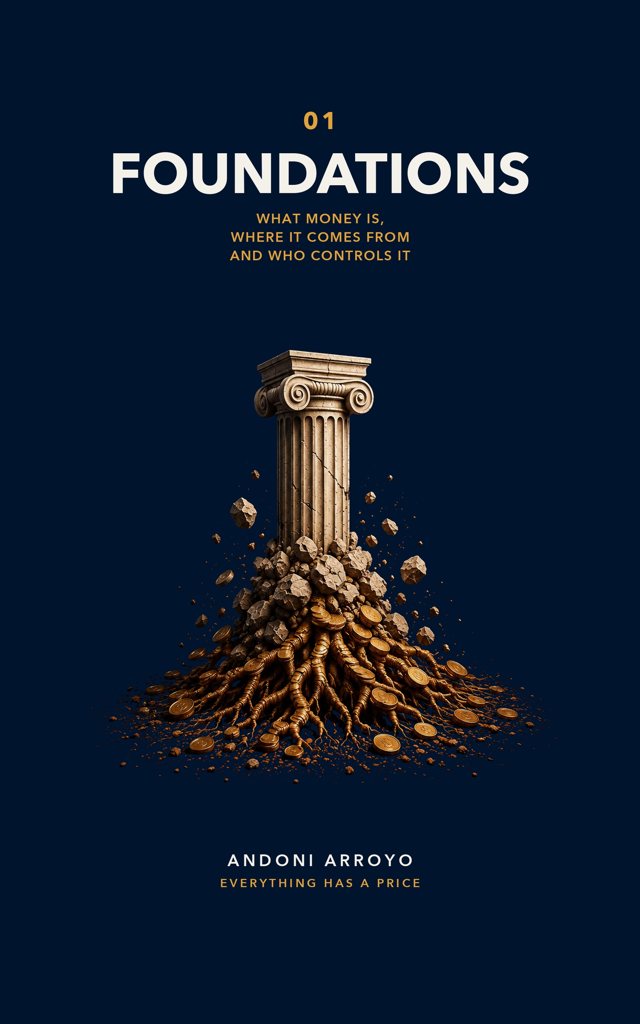
Cover of Everything Has a Price 01: Foundations

Everything Has a Price, Book 1 of 5

Foundations

What Money Is, Where It Comes From, and Who Controls It

Every morning, before you are properly awake, the economy has already touched you.

From a wheat field twelve thousand years ago to the heart of the modern financial system: why barter probably never existed the way you were told, what makes a piece of paper worth anything, and how banks create money every time they lend.

Or all five books in one Kindle ebook, one by one $24.95 now $9.99: The Complete Series (on Amazon from November 15).

The story inside

  1. Part 1The Origins of Money

    It begins long before coins. The Aztecs priced a rabbit at ten cocoa beans and a tamale at one, and people still found a way to counterfeit cocoa beans. On the island of Yap, a family was counted rich for a stone that had sunk to the ocean floor generations earlier. So what, exactly, makes money money?

  2. Part 2What Is Money?

    Then money becomes a promise. In 1640 Charles I seized some £130,000 in private gold kept in the Tower of London, and the way out of that tight spot ended up inventing something we all carry. Three centuries later, Charles de Gaulle sent French navy ships to New York to take France’s gold home. What had stopped him trusting the dollar?

  3. Part 3The Banking System

    Banks are older than anyone expects. In 1150 a French knight deposited his gold with warrior monks in Paris and collected it in Jerusalem, and not one coin made the journey. In Florence, in 1397, the Medici opened a bank in an age when interest was a mortal sin. And one night in November 1910, six men who had agreed to use first names only boarded a private railroad car at Hoboken.

  4. Part 4Interest, Debt, and Inflation

    Last comes the price of time. Benjamin Franklin left roughly a thousand pounds each to Boston and Philadelphia, on the condition that nobody touch it for two hundred years. In Berlin in 1923, someone stole a woman’s suitcase and left her banknotes on the sidewalk. And Hammurabi canceled every debt in his kingdom four times, not out of generosity.

3%

One finding from this book

of the money in the UK economy is notes and coins. The other 97% is bank deposits, created by ordinary banks, loan by loan.

Bank of England, Quarterly Bulletin, 2014

Full contents

See all 32 chapters in 4 parts
  1. Part 1: The Origins of Money

    1. You have wheat and you need shoes
    2. Barter: the story everyone knows
    3. Before money: debts, gifts, and favors
    4. Shells, salt, and cattle: the first monies
    5. The age of metals
    6. Lydia, 630 BC: the invention that split history in two
    7. Drachmas, denarii, and coins with holes
    8. What makes money money?
  2. Part 2: What Is Money?

    1. The three jobs of money
    2. When a dollar was a promise
    3. Trust: the invisible ingredient
    4. All that glitters: the rise of the gold standard
    5. The gilded cage
    6. Money from nothing: the birth of fiat
    7. Money vs currency
    8. What gives money its value?
  3. Part 3: The Banking System

    1. Temples and treasuries: the first banks
    2. God, gold, and the Templars
    3. The Medici and modern banking
    4. The goldsmith's trick
    5. How banks create money
    6. The Bank of England experiment
    7. The Fed and the secret meeting at Jekyll Island
    8. When everybody wants their money
  4. Part 4: Interest, Debt, and Inflation

    1. The price of time
    2. The eighth wonder of the world
    3. The rate that governs everything
    4. Too much money chasing too few goods
    5. When prices fall
    6. Wheelbarrows of banknotes
    7. The debt machine
    8. Is debt a sin?