Read the first pages of The Rules of the Game
Everything Has a Price, Book 2. The opening pages of Chapter 1, as they appear in the book.
Chapter 1
The invisible hand
In 1776, the same year the American colonists signed their Declaration of Independence, a Scottish professor published a book that would change the world in a completely different way.
It said nothing about political freedom. It talked about pins.
Yes, pins. Those little metal things you use to hold fabric together. With that apparently trivial story, Adam Smith launched an idea so powerful that we are still arguing about it 250 years later.
The idea was simple. Nobody needs to organize the economy from above. Nobody needs to tell the baker to bake bread or the shoemaker to make shoes. Each person, pursuing their own interest, ends up contributing to the well-being of everyone else.
As if an invisible hand were guiding the whole thing.
Is that true, or is it more complicated than it looks?
Let’s find out.
1
The moral philosopher who studied pins
Adam Smith was not an economist. That profession did not exist yet. He was a moral philosopher, a professor at the University of Glasgow, and his first major book was called The Theory of Moral Sentiments. It was about empathy, about justice, about why human beings care about one another.
This matters, because the popular image of Smith is badly distorted. He is presented as the apostle of selfishness, the father of cutthroat capitalism, the man who said greed is good.
He said nothing of the kind.
What Smith noticed was something much subtler. And he explained it with a pin factory.
He described a workshop where ten workers made pins. Each one handled a specific task. One drew out the wire. Another straightened it. A third cut it. A fourth sharpened the point. And so on, up to eighteen distinct operations.
The result? Ten people turned out 48,000 pins a day. Had each worker tried to make whole pins on his own, he might have managed twenty in a day. Perhaps not even one.
The difference did not come from working harder. It came from the division of labor: each person specialized in one task and became extraordinarily efficient at it.
Remember what we saw in Book 1: specialization multiplies production. Smith had spotted that two and a half centuries ago. But he went further. He asked something nobody had asked before.
Who organizes all of this?
The butcher, the brewer, and the baker
Think about it for a moment. In a city like Smith’s Glasgow, thousands of people need bread every morning. And every morning the baker is there, loaves ready.
Nobody orders the baker to get up early. No ministry calculates how many loaves Glasgow needs. No planner decides how much flour he should buy.
2
The baker makes bread because he wants to earn a living. It is his own interest that gets him out of bed at four in the morning.
Smith put it in a sentence that has become one of the most quoted in the history of economics:
“It is not from the benevolence of the butcher, the brewer, or the baker, that we expect our dinner, but from their regard to their own interest.”
Notice what he says and, above all, what he does not say. He does not say selfishness is a virtue. He does not say we ought to be selfish. What he says is that the system works through self-interest rather than in spite of it.
The baker wants to sell bread. To sell bread, he has to make good bread at a reasonable price. If his bread is bad, customers go to another baker. If he charges too much, the same thing happens.
The baker’s self-interest forces him to serve other people, out of necessity rather than generosity.
The hand that barely appears
This is where the famous invisible hand comes in. And this is where we need to be very careful, because the popular story strays quite far from what Smith actually wrote.
The phrase “invisible hand” appears exactly three times in all of Smith’s work. Three times, in thousands of pages. Once in his history of astronomy, an early essay. Once in The Theory of Moral Sentiments. And once in The Wealth of Nations.
3
It was not his central concept or his grand theory. It was a metaphor, used almost in passing, to describe something he found remarkable: when each individual tries to employ his capital in the way most advantageous to himself, he is “led by an invisible hand to promote an end which was no part of his intention.”
The order that emerges from the market is designed by nobody. There is no architect and no master plan. It is a spontaneous order that arises from millions of individual decisions.
That was revolutionary, because in 1776 the dominant idea was exactly the opposite.
Against mercantilism
To see why Smith’s book mattered so much, you need to understand what he was arguing against.
The dominant economic system in Europe through the sixteenth and seventeenth centuries, and much of the eighteenth, is called mercantilism. Its logic was simple. A nation’s wealth is measured by how much gold and silver it holds. To pile up gold and silver, you have to export more than you import. And to export more, the government has to intervene actively: tariffs on imports, subsidies for exports, monopolies granted to companies friendly with the king, state control of trade.
Mercantilism saw the economy as a zero-sum game. If France wins, Spain loses. If England wins, Holland loses. The world’s wealth was a fixed pie, and every nation was trying to grab the biggest slice.
Smith said this was a fundamental mistake. Wealth is not a fixed pie. When two countries trade freely, both can come out ahead. Trade is a form of cooperation, not a war.
4
And constant government intervention did not improve things, Smith argued. It distorted them. Tariffs protected inefficient producers. Monopolies killed competition. Subsidies steered resources to where the government wanted them, not to where they were most productive.
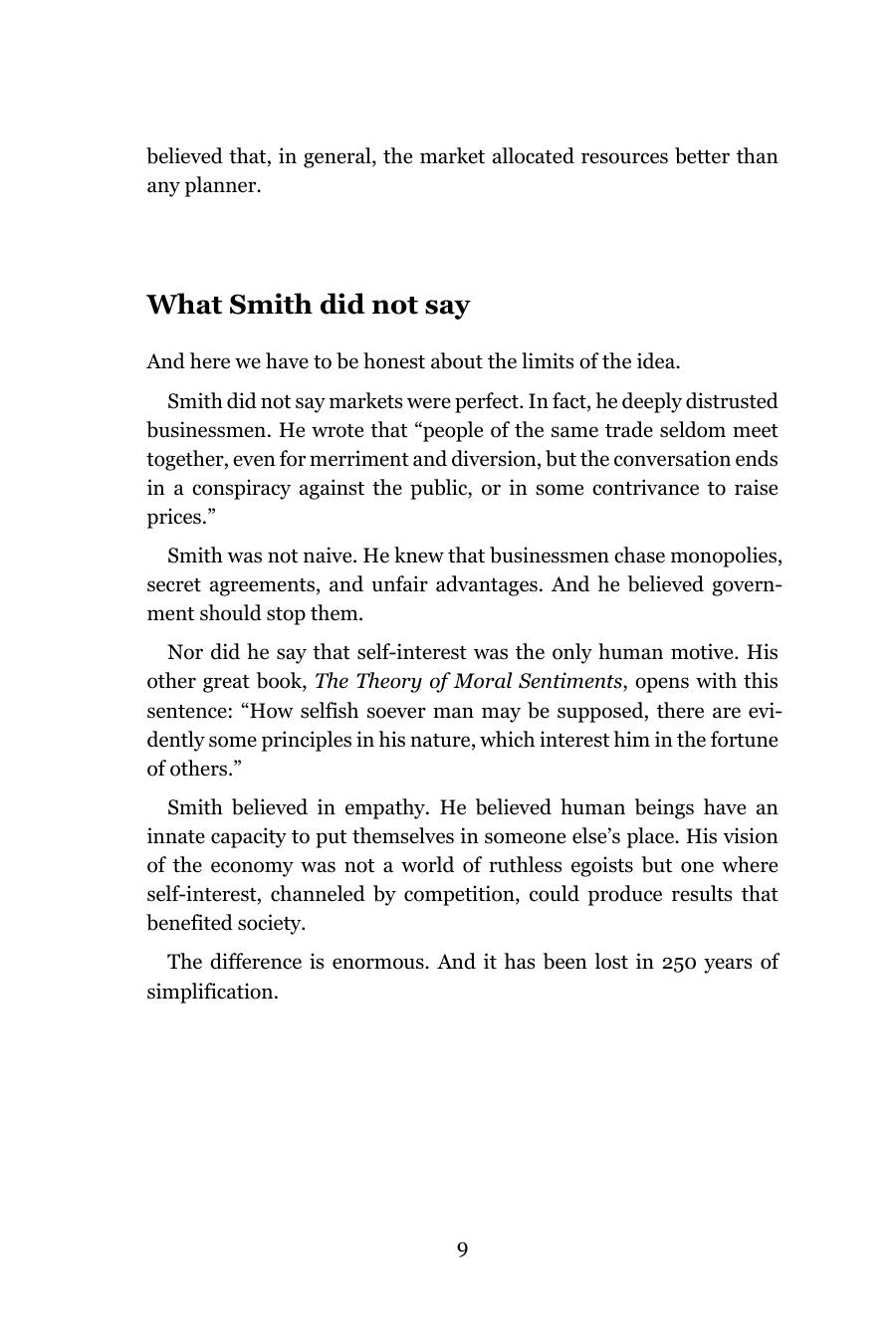
Smith was no anarchist. He recognized legitimate functions for the state: national defense, the administration of justice, and public works that no individual would have any incentive to pay for alone. But he believed that, in general, the market allocated resources better than any planner.
What Smith did not say
And here we have to be honest about the limits of the idea.
Smith did not say markets were perfect. In fact, he deeply distrusted businessmen. He wrote that “people of the same trade seldom meet together, even for merriment and diversion, but the conversation ends in a conspiracy against the public, or in some contrivance to raise prices.”
Smith was not naive. He knew that businessmen chase monopolies, secret agreements, and unfair advantages. And he believed government should stop them.
Nor did he say that self-interest was the only human motive. His other great book, The Theory of Moral Sentiments, opens with this sentence: “How selfish soever man may be supposed, there are evidently some principles in his nature, which interest him in the fortune of others.”
Smith believed in empathy. He believed human beings have an innate capacity to put themselves in someone else’s place. His vision of the economy was not a world of ruthless egoists but one where self-interest, channeled by competition, could produce results that benefited society.
The difference is enormous. And it has been lost in 250 years of simplification.
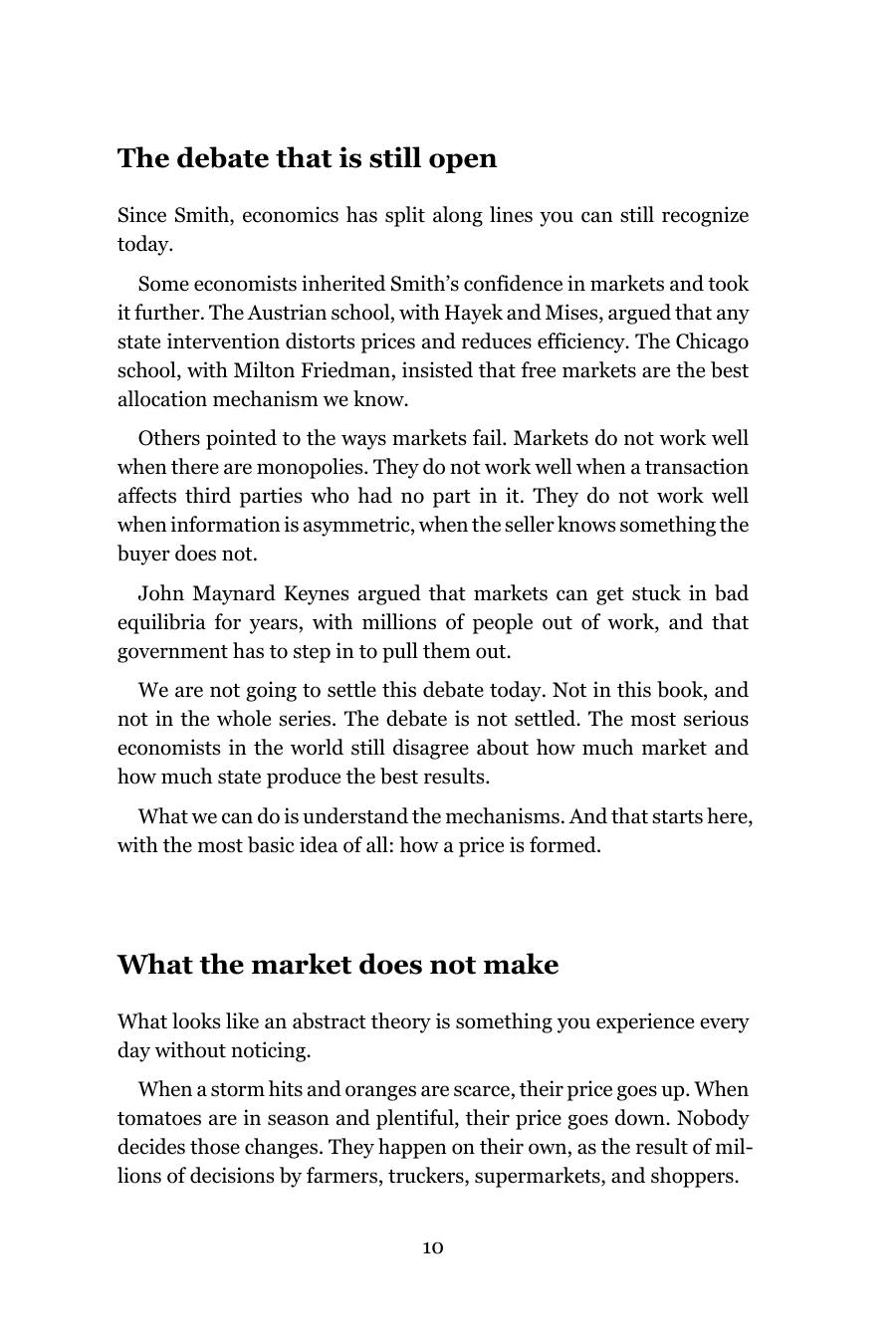
The debate that is still open
Since Smith, economics has split along lines you can still recognize today.
5
Some economists inherited Smith’s confidence in markets and took it further. The Austrian school, with Hayek and Mises, argued that any state intervention distorts prices and reduces efficiency. The Chicago school, with Milton Friedman, insisted that free markets are the best allocation mechanism we know.
Others pointed to the ways markets fail. Markets do not work well when there are monopolies. They do not work well when a transaction affects third parties who had no part in it. They do not work well when information is asymmetric, when the seller knows something the buyer does not.
John Maynard Keynes argued that markets can get stuck in bad equilibria for years, with millions of people out of work, and that government has to step in to pull them out.
We are not going to settle this debate today. Not in this book, and not in the whole series. The debate is not settled. The most serious economists in the world still disagree about how much market and how much state produce the best results.
What we can do is understand the mechanisms. And that starts here, with the most basic idea of all: how a price is formed.
What the market does not make
What looks like an abstract theory is something you experience every day without noticing.
When a storm hits and oranges are scarce, their price goes up. When tomatoes are in season and plentiful, their price goes down. Nobody decides those changes. They happen on their own, as the result of millions of decisions by farmers, truckers, supermarkets, and shoppers.
6
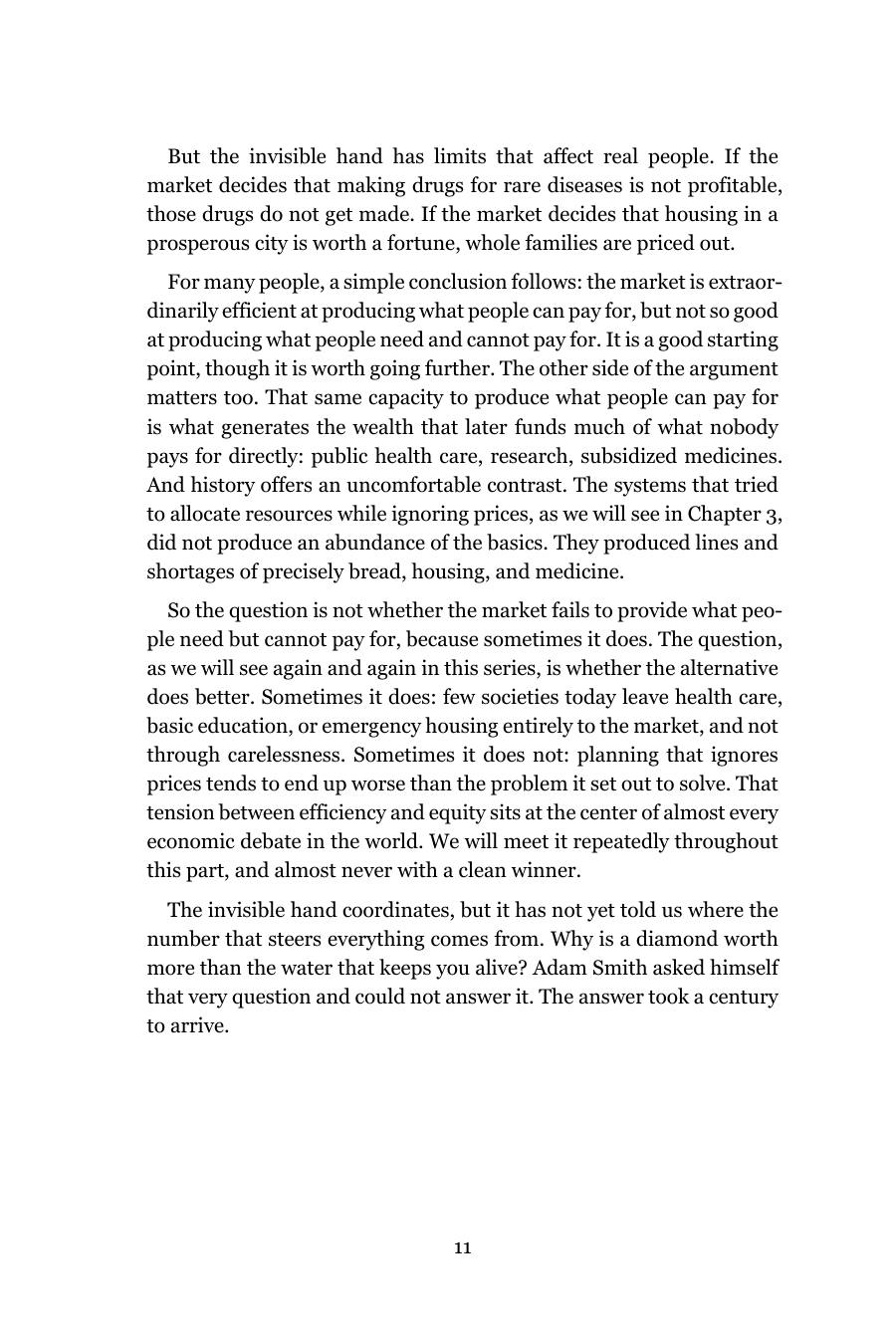
But the invisible hand has limits that affect real people. If the market decides that making drugs for rare diseases is not profitable, those drugs do not get made. If the market decides that housing in a prosperous city is worth a fortune, whole families are priced out.
For many people, a simple conclusion follows: the market is extraordinarily efficient at producing what people can pay for, but not so good at producing what people need and cannot pay for. It is a good starting point, though it is worth going further. The other side of the argument matters too. That same capacity to produce what people can pay for is what generates the wealth that later funds much of what nobody pays for directly: public health care, research, subsidized medicines. And history offers an uncomfortable contrast. The systems that tried to allocate resources while ignoring prices, as we will see in Chapter 3, did not produce an abundance of the basics. They produced lines and shortages of precisely bread, housing, and medicine.
So the question is not whether the market fails to provide what people need but cannot pay for, because sometimes it does. The question, as we will see again and again in this series, is whether the alternative does better. Sometimes it does: few societies today leave health care, basic education, or emergency housing entirely to the market, and not through carelessness. Sometimes it does not: planning that ignores prices tends to end up worse than the problem it set out to solve. That tension between efficiency and equity sits at the center of almost every economic debate in the world. We will meet it repeatedly throughout this part, and almost never with a clean winner.
7
The invisible hand coordinates, but it has not yet told us where the number that steers everything comes from. Why is a diamond worth more than the water that keeps you alive? Adam Smith asked himself that very question and could not answer it. The answer took a century to arrive.
8
That is where the free pages end.