Everything Has a Price
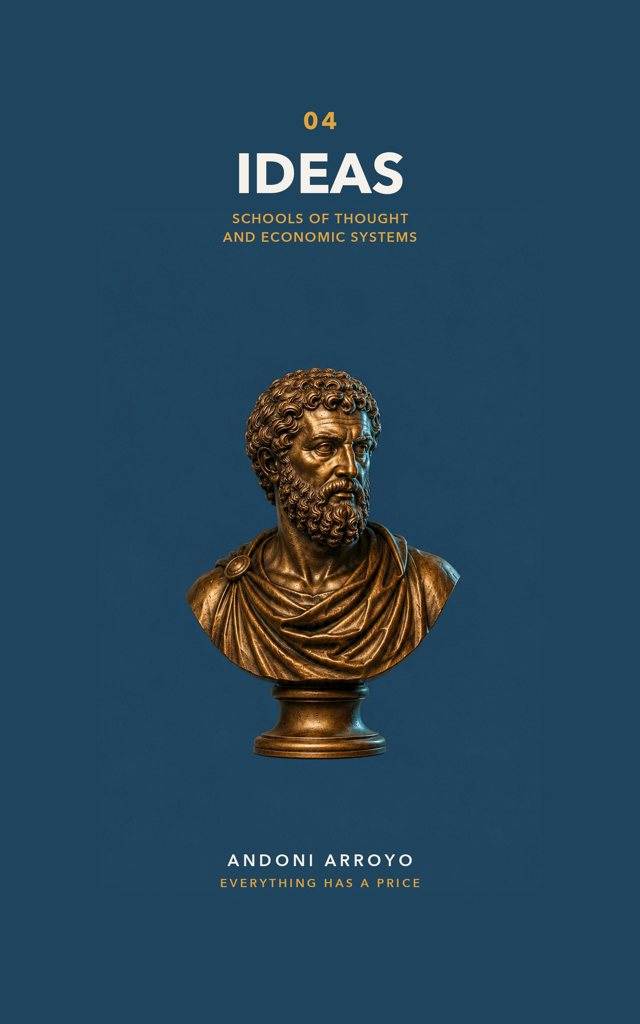
Cover of Everything Has a Price 04: Ideas

Everything Has a Price, Book 4 of 5

Ideas

Schools of Thought and Economic Systems

Behind every tax, every bailout, and every border that opens or closes, there is an idea.

The arguments that have never been settled: why brilliant economists looking at the same facts reach opposite conclusions, and how those arguments became entire ways of running a country.

Or all five books in one Kindle ebook, one by one $24.95 now $9.99: The Complete Series (on Amazon from November 15).

New to the series? It stands on its own, but it starts with Book 1, Foundations.

The story inside

  1. Part 1Schools of Thought

    In the early 1870s three men who had never met, in England, in Austria and in Lausanne, solved the same century-old riddle about water and diamonds. A hundred years later a Kodak engineer built the first digital camera, an eight-pound box that took twenty-three seconds per black-and-white photo and saved it to a cassette tape. And in 1969 Fernando Henrique Cardoso helped found dependency theory; twenty-six years later he was president of Brazil. What did he do once he was in charge?

  2. Part 2Economic Systems and the -isms

    Then the ideas become systems. Charles Fourier designed communities of exactly 1,620 people, and his followers founded about twenty-five of them in 1840s America. Otto von Bismarck, who had tried to outlaw the socialists, gave workers compulsory health insurance in 1883. Park Chung-hee built a steel mill in a fishing village against a report that called it not viable. And in 1947 Friedrich Hayek gathered thirty-nine intellectuals in a hotel above Lake Geneva, and hardly anyone paid attention. Until the 1970s.

1/3

One finding from this book

of America's money supply vanished between 1929 and 1933. In 2002 a Fed governor told Milton Friedman: “You’re right, we did it.”

Friedman and Schwartz, A Monetary History of the United States, 1963; Ben Bernanke, 2002

Full contents

See all 20 chapters in 2 parts
  1. Part 1: Schools of Thought

    1. Smith and the classical economists
    2. What Marx saw
    3. The marginal revolution
    4. The Austrians
    5. Keynes changes everything
    6. Schumpeter and creative destruction
    7. Friedman and the Chicago Boys
    8. Institutions matter
    9. Structuralism and the view from the periphery
    10. The irrational economy
  2. Part 2: Economic Systems and the -isms

    1. What capitalism really is
    2. Liberalism: the original
    3. Socialism: many socialisms
    4. Communism: theory and reality
    5. Corporatism and the fascist economy
    6. State capitalism and the developmental state
    7. The welfare state
    8. Neoliberalism and its discontents
    9. Libertarians, anarchists, and minarchists
    10. Beyond growth